Which cooling system design, ducted, split, or through-wall, suits a private wine cellar?
The three main families of active cellar cooling differ in noise, installation cost, capacity, and where the heat goes. Here is how they compare and which one belongs in which kind of home.

Through-wall units: simplest, and the most limited
A through-wall or self-contained unit is a single box, similar in concept to a window air conditioner, that mounts in an opening in the cellar wall. The cold side faces the cellar and the hot side faces an adjacent room, which absorbs the rejected heat. Installation is straightforward, the cost is the lowest of the three, and there is no refrigerant line to run. For a small, well-insulated cellar in a basement with a large, cool adjacent room, it can be an entirely sensible choice. Related: How much does building a bespoke private wine cellar typically cost overall?
The limitations are that the adjacent space must be able to absorb the heat without warming up, the unit is audible on both sides of the wall, and the cellar-side face is visible among your racking. Capacity tops out lower than the other designs, which rules these units out for glass rooms and larger cellars. Because the whole machine lives in the wall, service means pulling it, and a failure takes the entire system down at once. Related: What conditions must a private wine cellar hold to protect fine bottles?
Keep reading: What conditions must a private wine cellar hold to protect fine bottles?, How do you choose between passive and active cooling for a wine cellar?, What is the ideal temperature and humidity for storing wine long term?. See how Cellarvo helps you a refined guide to building and cooling a private wine cellar.
Split systems: quiet inside, flexible outside
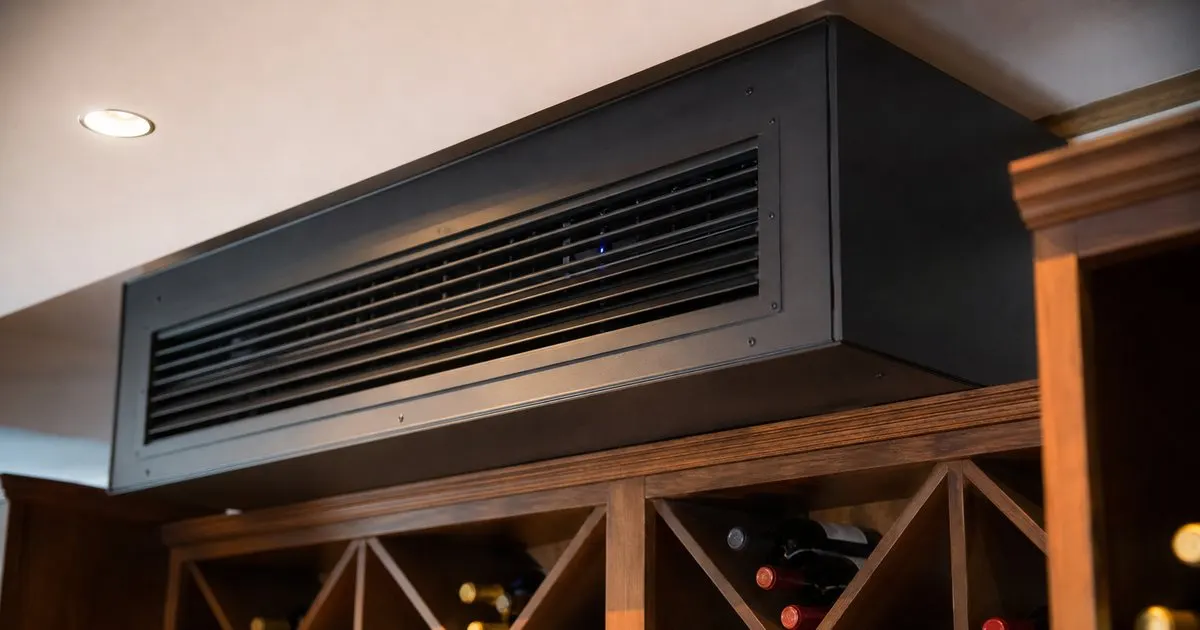
A split system separates the evaporator, which sits inside the cellar, from the condensing unit, which is placed elsewhere, often outdoors, in a garage, or in a mechanical room, and connects the two with a refrigerant line set. The result is a cellar that is noticeably quieter, a compact interior unit that can be tucked above the racking, and freedom to put the noisy, heat-producing half somewhere it does no harm. Split systems are typically the choice for mid-size to large cellars and for anything with glass.
The trade-off is installation complexity. A licensed refrigeration technician must run and charge the line set, and the condenser location needs to be within the line-length limits the manufacturer specifies. Outdoor condensers must be rated for your climate, including winter operation in cold regions, where a low-ambient kit is often required. Costs are higher than a through-wall unit, but so is the ceiling on performance and the long-term serviceability. Related: What is the ideal temperature and humidity for storing wine long term?
Ducted systems: invisible, and the most demanding to plan
A ducted system keeps the entire cooling unit outside the cellar, in a mechanical space, and delivers cold air through insulated ducts to a supply grille inside the room, with a return duct carrying air back. Nothing mechanical is visible in the cellar, and nothing inside it makes noise. Air can be introduced exactly where it is needed, such as along a glass wall, and the unit itself can be serviced without anyone entering the cellar. Related: How do you choose between passive and active cooling for a wine cellar?
Ducted designs must be planned into the construction. Duct runs need to be short, insulated, and sealed; the mechanical space must have room and ventilation for the unit's rejected heat; and the ceiling or wall must accommodate the grilles. These systems are common in high-end new construction and major renovations where the architect and mechanical designer are involved early. Retrofitting one into a finished home is possible but often the most expensive path of the three.
Matching the design to your cellar and your home
For a small basement cellar with a cool utility room next door, a through-wall unit remains a perfectly good answer and the least expensive to install. For most cellars in the range that a serious collector builds, a split system offers the best balance of quiet, capacity, and flexibility, and it is the design installers most often recommend. For glass rooms, cellars adjacent to living space, and homes where nothing may be seen or heard, ducted is the premium choice.
Whichever family you choose, the same fundamentals apply: the unit must be sized to the calculated heat load, the heat must have somewhere to go, and the cellar itself must be sealed and insulated. We may earn a commission on some products we link to as an independent guide, and none of the three designs is universally best. The right one is the one that fits the room, the house, and the level of quiet you expect from a luxury space.
- Through-wall units are inexpensive and simple but limited in capacity, audible, and dependent on a cool adjacent room.
- Split systems put the noise and heat elsewhere and suit most serious cellars, including glass rooms.
- Ducted systems are silent and invisible inside the cellar but must be designed into the construction.
- Every design still depends on correct sizing, a proper heat rejection path, and a well-sealed room.

Julien Jimenez
Julien Jimenez is an independent software builder based in Paris. He designs, ships, and operates focused SaaS products for small businesses and independent professionals. Read the full author page.
A Cellar Worthy Of The Bottles
A refined guide to building and cooling a private wine cellar. Cellarvo is built to help you put this into practice.
Plan your cellarMore from the Cellarvo blog


Get the complete wine cellars guide
Our full buying guide, the price guide, and new research as we publish it. One email, no spam, unsubscribe any time.