What should a homeowner look for when choosing a sealed wine cellar door?
The door is the weakest point in most cellar envelopes and the first thing a guest touches. Here is how to choose one that seals like an exterior door and looks like it belongs in the house.
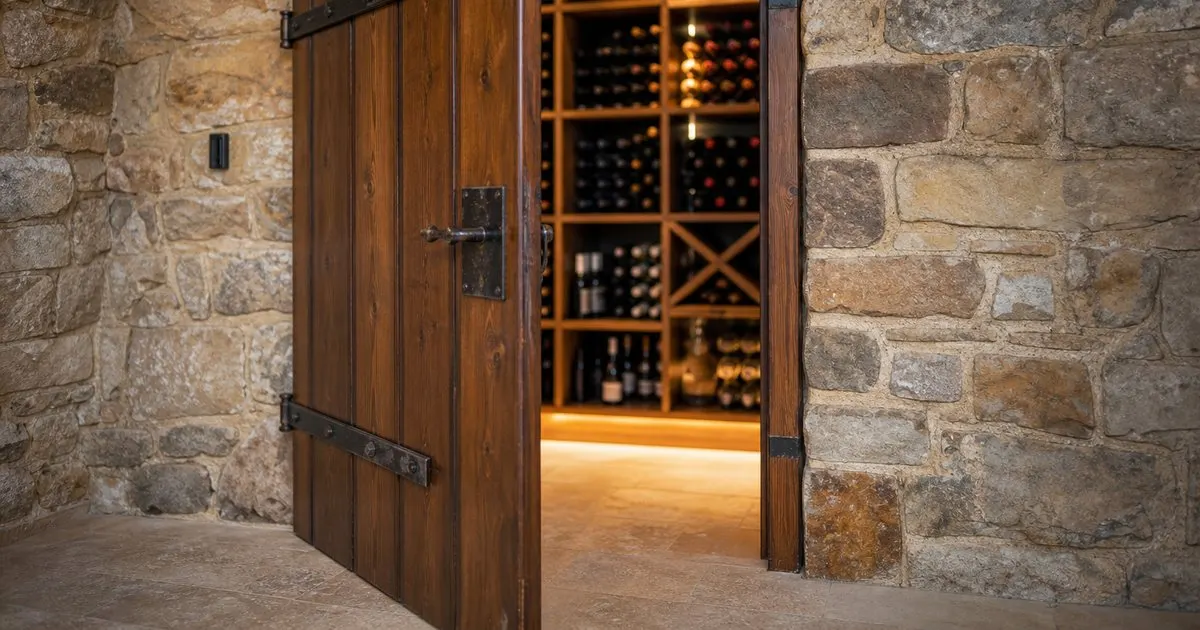
Why the door matters more than any wall
A cellar wall is a continuous, insulated, vapor-sealed assembly. The door interrupts it with a moving panel, a frame, hinges, a threshold, and a gap around all four edges. If that gap is not sealed, warm and humid air moves into the cellar every hour of every day, the cooling unit works harder, and moisture condenses on the cold side of the door and frame. Many cellars with mysterious humidity or temperature problems turn out to have a door that was chosen for looks alone. Related: How do you choose between passive and active cooling for a wine cellar?
The right mental model is an exterior door. It needs a weatherstripped frame on all three sides, a threshold with a sweep or automatic drop seal at the bottom, and a panel with enough insulation value that its inner face stays cool without sweating. Interior passage doors, even beautiful solid-wood ones, are not built that way, and hanging one in a cellar opening is one of the most common mistakes in residential cellar construction.
Keep reading: What conditions must a private wine cellar hold to protect fine bottles?, How do you choose between passive and active cooling for a wine cellar?, What is the ideal temperature and humidity for storing wine long term?. See how Cellarvo helps you a refined guide to building and cooling a private wine cellar.
Solid, glass, or a combination
A solid insulated door, typically wood-clad over a foam core or a solid hardwood slab of substantial thickness, offers the best thermal performance and complete darkness. It suits traditional cellars, basement rooms, and any cellar where the collection matters more than the view. Exterior-grade wood doors with a proper finish handle the humidity gradient well, and iron or bronze hardware adds the character many owners want. Related: What is the ideal temperature and humidity for storing wine long term?
Glass doors are the fashionable alternative and can be excellent, provided the glass is an insulated unit, ideally with a low-emissivity coating and a thermally broken frame, and the door is gasketed on all sides. A full-view glass door turns the cellar into a display and lets the room read as part of the home. Its weaknesses are the same as a glass wall: higher heat gain and condensation risk in humid climates. Many owners choose a glass panel within a solid, insulated frame as a balance.
Hardware, seals, and the details that fail
Look for a continuous compression gasket in the frame rather than a simple foam strip, a bottom seal that fully closes the gap to the finished floor, and an automatic closer or a latch that pulls the door tight against the gasket. A cellar door that is left ajar for a minute is a minor issue; one that never quite seals is a permanent one. Hinges must carry the weight of an insulated slab without sagging over time, which is why heavy-duty ball-bearing hinges are typical. Related: What conditions must a private wine cellar hold to protect fine bottles?
Consider the swing direction and what is on the far side. An outswing door keeps the full interior available for racking and lets the gasket compress against the frame when the cellar's cooler, denser air pushes outward. Confirm that the threshold detail works with the finished floors on both sides, which are often different materials at different heights. These small details are where a beautiful door either performs like an exterior door or quietly undermines the room.
Working with a maker or a millwork shop
Specialty cellar door makers build for this application and understand the seals, thermal breaks, and insulated cores that matter. Custom millwork shops can also produce an excellent door if you specify the requirements clearly: insulated core or insulated glass, full perimeter gasketing, a bottom seal, exterior-grade construction and finish. Ask to see how the frame is sealed and where the gasket lands; a shop that treats it as an ordinary interior door will produce an ordinary interior door. Related: How much does building a bespoke private wine cellar typically cost overall?
Budget for the door as a component of the mechanical system, not a piece of trim. It is not unusual for a well-made insulated cellar door to cost as much as a modest cooling unit, and the two work together. As an independent guide we may earn a commission on some products we link to, but our advice is the same regardless: the money spent on a sealed, insulated door is money the cooling system will never have to spend fighting a draft.
- Treat the cellar door as an exterior door: insulated panel, full perimeter gasket, and a bottom seal.
- Solid insulated doors perform best; glass doors work when the glass is insulated, low-emissivity, and thermally broken.
- Hardware matters: compression gaskets, drop seals, closers, and heavy-duty hinges keep the door sealed for years.
- Specify requirements clearly to any maker and budget for the door as part of the mechanical system.

Julien Jimenez
Julien Jimenez is an independent software builder based in Paris. He designs, ships, and operates focused SaaS products for small businesses and independent professionals. Read the full author page.
A Cellar Worthy Of The Bottles
A refined guide to building and cooling a private wine cellar. Cellarvo is built to help you put this into practice.
Plan your cellarMore from the Cellarvo blog

Get the complete wine cellars guide
Our full buying guide, the price guide, and new research as we publish it. One email, no spam, unsubscribe any time.