How much maintenance does a wine cellar cooling unit actually need each year?
Cellar cooling systems are quietly reliable until they are neglected. A short seasonal routine and one professional visit a year keep the room stable and the compressor alive for its full working life.
What the owner should do every season
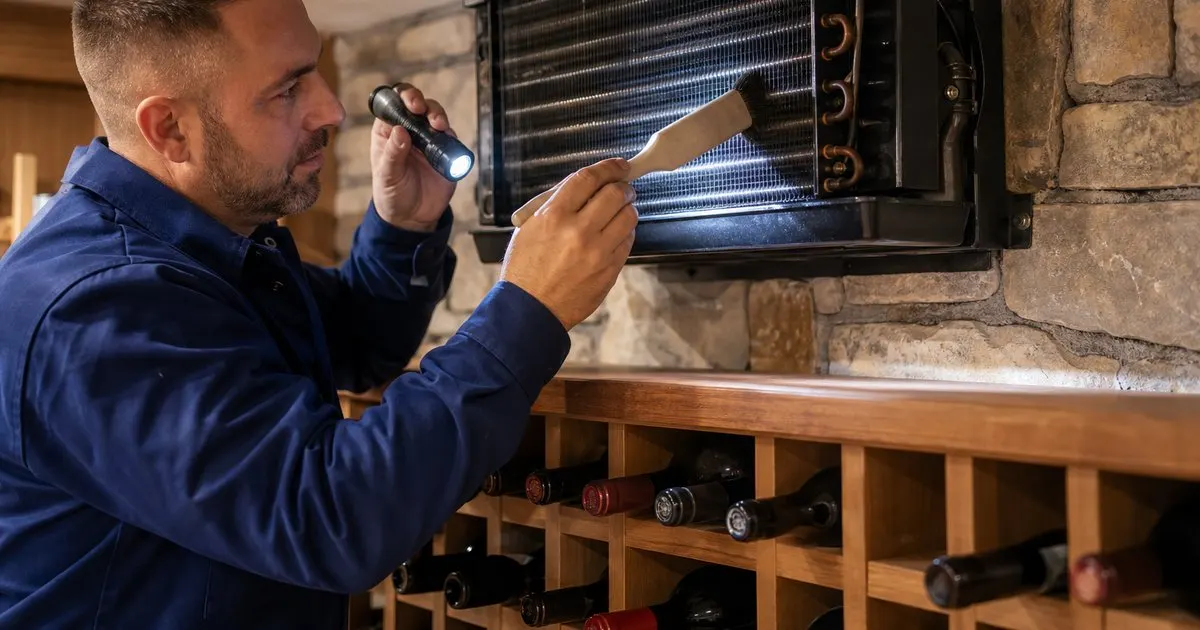
The most valuable maintenance is also the simplest: keep the condenser side clean. Dust, pet hair, and lint accumulate on the condenser coil and fins, and a fouled coil cannot reject heat, so the unit runs longer, cools less, and wears faster. Every few months, switch the unit off, vacuum or gently brush the coil and any intake grille, and confirm nothing has been stored against the unit that blocks airflow. In a garage or utility room this needs doing more often than in a finished basement.
Inside the cellar, check the evaporator side for frost or ice, which signals airflow or refrigerant problems, and look at the condensate drain line or pan, which should be clear and dry rather than overflowing or growing anything. Confirm the temperature and humidity readings against an independent thermometer and hygrometer placed among the bottles, because a thermostat reads the air at the unit, not at the wine. Note what you see; a short log makes the professional's job easier. Related: What conditions must a private wine cellar hold to protect fine bottles?
Keep reading: What conditions must a private wine cellar hold to protect fine bottles?, How do you choose between passive and active cooling for a wine cellar?, What is the ideal temperature and humidity for storing wine long term?. See how Cellarvo helps you a refined guide to building and cooling a private wine cellar.
What a professional should do annually
A yearly visit from a refrigeration technician familiar with cellar equipment is the standard recommendation and a sound one. The technician will check refrigerant pressure and look for slow leaks, inspect electrical connections and capacitors, test the fan motors, clean the coils thoroughly, flush the condensate drain, verify that the controller and any sensors are calibrated, and check the seals on the ductwork or the wall opening. Most of these are small items; catching them early is what prevents the compressor from failing on a July weekend.
For split systems, the visit should include the outdoor condenser: clearances, coil cleanliness, and, in cold climates, the low-ambient control that lets the unit operate in winter. Ask the technician to record the readings so you can compare year to year. A gradually rising run time or a slowly falling refrigerant charge tells a story long before the unit stops working, and these numbers are the early warning that lets you plan a repair rather than suffer an emergency.
Signs that something is wrong between visits
Learn what the unit sounds like when it is healthy, and pay attention when it changes. A new rattle, a hum with no airflow, or a compressor that clicks on and off in short bursts each deserve a call. Temperature that creeps up over days while the unit runs constantly usually means a dirty coil, a low refrigerant charge, or a heat rejection problem in the space where the condenser lives. Ice on the evaporator means airflow is restricted or the charge is wrong. Related: Which room or space in a home suits a wine cellar best?
Humidity moving outside its normal band is subtler. Very dry air in the cellar often indicates the unit is cycling too aggressively or running too cold; excess moisture or a musty smell points to a drain problem, an envelope leak, or a vapor barrier failure. None of these are reasons to panic, but all of them are reasons not to wait. A cellar drifts slowly, and the wine is patient right up until the day it is not. Related: How do you choose between passive and active cooling for a wine cellar?
Lifespan, warranty, and when to plan a replacement
Well-maintained cellar cooling units typically run for a decade or longer, and some considerably beyond, although the compressor and fan motors are wear items and may need replacement along the way. Keep the warranty documents, register the unit at installation, and understand what the warranty covers and what it requires, since some manufacturers condition coverage on professional installation or documented service. A maintenance record is worth keeping for the same reason. Related: How much does building a bespoke private wine cellar typically cost overall?
When repair costs begin to approach a meaningful share of a new unit, or when parts become hard to find, it is time to plan a replacement on your own schedule rather than the unit's. Newer equipment is often quieter and more efficient, and replacing on a planned date means the cellar never sits warm while parts are ordered. As an independent guide we may earn a commission on some products we link to, but the point stands: an hour of care each season is the cheapest insurance a collection can buy.
- Keep the condenser coil and intake clean every season; it is the single most effective maintenance task.
- Schedule one professional refrigeration visit a year and ask for the readings to be recorded.
- Watch for short cycling, constant running, ice on the evaporator, and humidity outside its normal band.
- Plan replacement before failure once repairs grow expensive or parts become scarce.

Julien Jimenez
Julien Jimenez is an independent software builder based in Paris. He designs, ships, and operates focused SaaS products for small businesses and independent professionals. Read the full author page.
A Cellar Worthy Of The Bottles
A refined guide to building and cooling a private wine cellar. Cellarvo is built to help you put this into practice.
Plan your cellarMore from the Cellarvo blog
Get the complete wine cellars guide
Our full buying guide, the price guide, and new research as we publish it. One email, no spam, unsubscribe any time.