Why does a glass-walled wine cellar need more cooling capacity than a closed room?
Glass cellars are the signature look of modern luxury homes, and they are also the hardest rooms to hold at 55 degrees. Here is what the glass does to your thermal load and how to design around it.
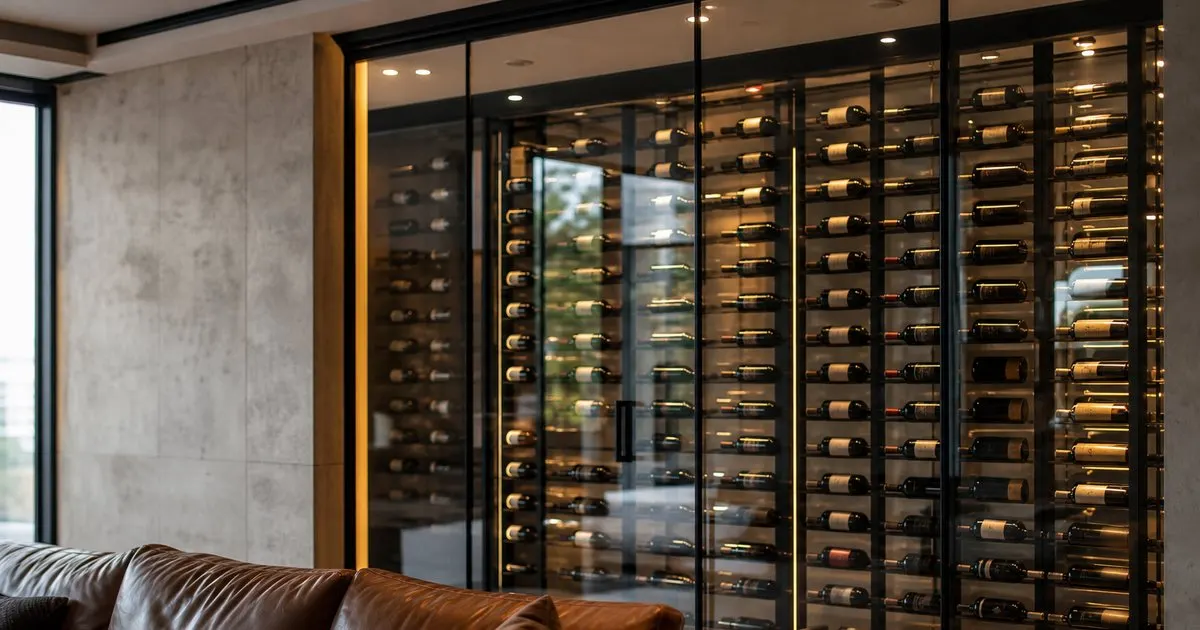
What glass does to a thermal envelope
An insulated cellar wall is built to resist heat flow: framing, closed-cell foam or batts with a vapor barrier, drywall or wood cladding. Glass does the opposite. Even high-quality double-pane, low-emissivity glass conducts heat far faster than a properly insulated wall of the same area, and a single-pane panel is dramatically worse. When one entire side of the cellar is glass, that surface dominates the heat load and the rest of the envelope becomes almost irrelevant to the calculation. Related: How important is insulation and a vapor barrier in a wine cellar?
Glass also admits radiant heat. A cellar that receives direct sunlight through its glass, or through a nearby window, will absorb energy the cooling unit must then remove, and the bottles closest to the glass will see the widest swings. Interior placement helps, but even indirect daylight and the warm air of a living room pressing against the pane add up. Designers who specialize in these rooms treat the glass as the primary design constraint rather than a finish detail. Related: What conditions must a private wine cellar hold to protect fine bottles?
Keep reading: What conditions must a private wine cellar hold to protect fine bottles?, How do you choose between passive and active cooling for a wine cellar?, What is the ideal temperature and humidity for storing wine long term?. See how Cellarvo helps you a refined guide to building and cooling a private wine cellar.
Condensation, the problem nobody expects
A cellar at 55 degrees and 60 percent relative humidity is cold and moist by household standards. Where the warm, humid air of a summer living room meets the cold surface of the cellar glass, water condenses, exactly as it does on a glass of iced tea. Fogged or dripping glass ruins the visual effect the room was built for, and persistent moisture at the frame can damage flooring and drywall around the enclosure over time. Related: What is the ideal temperature and humidity for storing wine long term?
The remedy is a combination of better glass and thoughtful air management. Insulated glass units with a thermal break in the frame keep the interior pane warmer, and some installers specify glass with a heated film or a warm-air wash across the exterior surface in humid climates. Just as important, the home's own HVAC should keep the space outside the cellar reasonably dry. A glass cellar in a humid coastal home with no dehumidification will fog no matter how good the glass is. Related: Which room or space in a home suits a wine cellar best?
Matching the cooling system to the glass
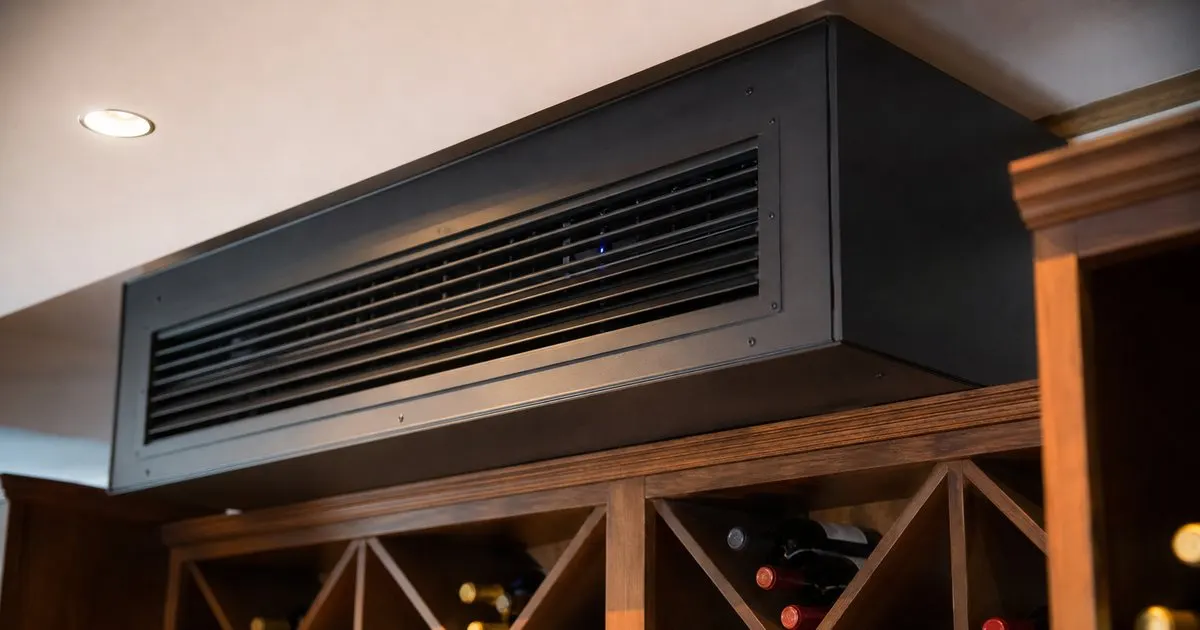
Because the load is high and often variable across the day, glass cellars typically call for a ducted or split system with more capacity than a closed room of the same volume. A through-wall self-contained unit rarely has the headroom, and its noise is harder to hide in a room that sits in the middle of the living space. Ask the installer to run the heat load using the actual glass specification, including the frame, not a generic wall value.
Airflow inside the enclosure matters as much as raw capacity. Supply air should wash across the glass so the coldest air is not pooling at the floor while the top of the enclosure warms against the living room ceiling. Some designs route a supply grille along the top of the glass wall for this reason. Full-height glass with an open-plan room around it is essentially a cold column standing in a warm space, and the mechanical design has to respect that.
Design choices that reduce the burden
Not every surface has to be glass to achieve the effect. A glass front with insulated side walls and an insulated ceiling holds temperature far more easily than a four-sided glass box, and it is usually a better backdrop for the bottles anyway. Solid-back racking, a rear wall in stone or wood, and glass limited to the viewing face are common compromises in well-designed homes. Keeping the enclosure away from windows and away from kitchen heat sources helps considerably.
Finally, be honest about how the room will be used. A glass cellar that doubles as a tasting space, opened often and lit for entertaining, carries a load its designer must plan for. Choosing dimmable, low-heat LED lighting, an automatic door closer, and a door with a proper gasket makes a real difference. The glass cellar can be an extraordinary feature, but it is a piece of mechanical engineering wearing a beautiful skin, and it should be designed that way from the first sketch.
- Glass conducts heat far faster than an insulated wall, so it dominates the cellar's thermal load.
- Condensation on the glass is a design problem, solved with thermally broken insulated glass and a dry surrounding room.
- Glass cellars usually need a ducted or split system with more capacity than a closed room of equal volume.
- Limiting glass to the viewing face and keeping the enclosure away from sun and kitchen heat reduces the burden.

Julien Jimenez
Julien Jimenez is an independent software builder based in Paris. He designs, ships, and operates focused SaaS products for small businesses and independent professionals. Read the full author page.
A Cellar Worthy Of The Bottles
A refined guide to building and cooling a private wine cellar. Cellarvo is built to help you put this into practice.
Plan your cellarMore from the Cellarvo blog

Get the complete wine cellars guide
Our full buying guide, the price guide, and new research as we publish it. One email, no spam, unsubscribe any time.