What questions should you ask a wine cellar contractor before signing a build contract?
A cellar build joins carpentry, refrigeration and building science in one small room, and few firms are genuinely strong at all three. These are the questions that reveal which kind you are talking to.

Who Owns the Building Science
A wine cellar is not a finished basement room with a cooler bolted to the wall. It is a small, cold, humid box built inside a warm, dry house, and the pressure that difference creates will find every weakness in the assembly. The single most useful question you can put to a prospective contractor is where the vapor barrier goes and which side of the framing it sits on. A builder who answers immediately, and explains why the barrier belongs on the warm side of the insulation in most US climates, has done this before. One who says the drywall will take care of it has not. Related: What conditions must a private wine cellar hold to protect fine bottles?
Follow that with the rest of the envelope. Ask what insulation value they specify for walls and ceiling, how they treat the floor when the room sits above conditioned space, and how they seal the penetrations for lighting, wiring and the cooling unit. Then ask the uncomfortable question: who is responsible if condensation appears inside a wall two winters from now. What you want is a single point of accountability, not a careful description of how the framing crew, the insulator and the refrigeration sub each handled their own portion.
Keep reading: What conditions must a private wine cellar hold to protect fine bottles?, How do you choose between passive and active cooling for a wine cellar?, What is the ideal temperature and humidity for storing wine long term?. See how Cellarvo helps you a refined guide to building and cooling a private wine cellar.
Refrigeration Is Its Own Trade
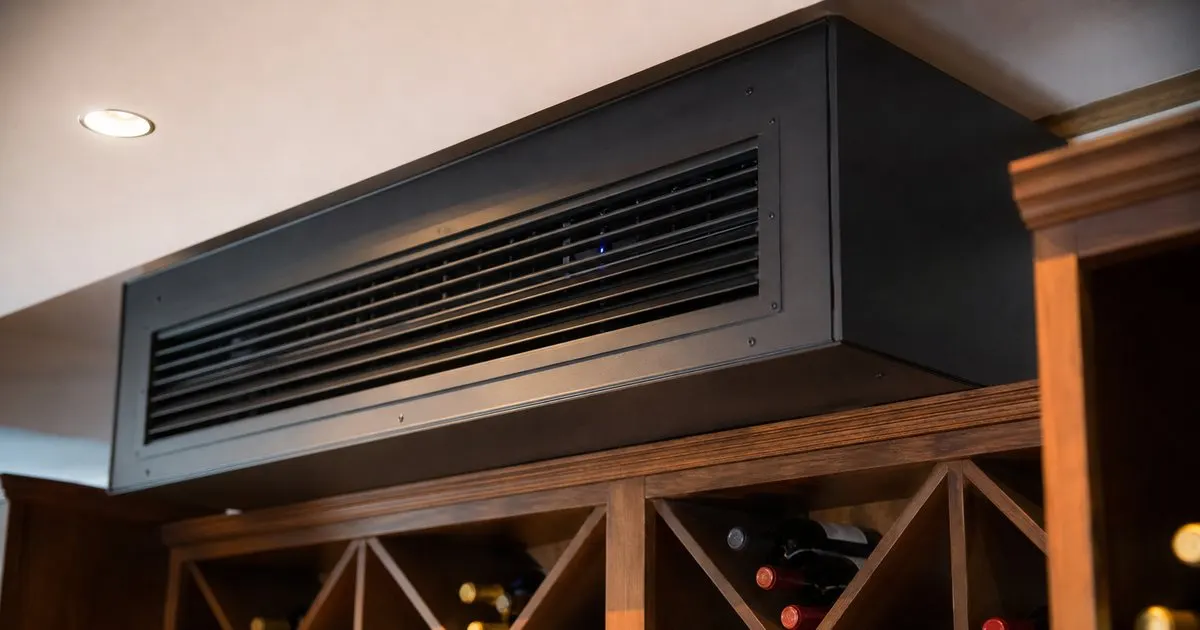
Cooling is where cellar projects most often go wrong, because carpentry firms rarely employ refrigeration technicians and refrigeration firms rarely build rooms. Ask directly who performs the cooling load calculation, what goes into it, and whether you may see the assumptions. A credible answer references room volume, insulation values, glass area, the ambient temperature of the adjacent space, expected door traffic and lighting heat. An answer that maps your square footage straight onto a catalog model, without a single question about the room around it, is a guess dressed as a specification.
Then ask the installation questions that show up later as service calls. Where does condensate drain, and does that route rely on gravity or on a pump that can fail quietly. How is the unit isolated so its vibration does not travel into the racking. If the system is split or ducted, where do the line sets or ducts run, and how much static pressure is the fan expected to overcome. Confirm that a licensed HVAC contractor makes the refrigerant connections, because in most US jurisdictions that work is regulated and a general carpenter cannot legally perform it.
What the Contract Should Say Out Loud
Verbal promises evaporate somewhere between the showroom and the punch list. The contract should state the finished bottle capacity as a number, name the racking species and finish, and list the cooling equipment by type and capacity rather than burying it in an allowance. Where allowances genuinely are unavoidable, for stone flooring or a glass door, they should carry a specific dollar figure so that an upgrade later becomes a visible change order instead of a surprise at closing. Budgets for a bespoke cellar are large enough that a vague line item costs real money. Related: How do you choose between passive and active cooling for a wine cellar?
Insist on a commissioning step. A finished cellar should be run empty and held at target for a defined period, with temperature and humidity logged at more than one height in the room, before you accept the work and move wine in. Write that test into the contract with a pass condition both sides understand, alongside a punch list process and a retention amount released only once the room proves stable. Firms that build cellars regularly expect to be asked for this. Firms that do not will explain why it is unnecessary. Related: What is the ideal temperature and humidity for storing wine long term?
Warranty, Service and What Happens in Year Three
Equipment warranty and workmanship warranty are separate instruments, and both matter more here than in an ordinary remodel, because a cellar failure is silent until the wine is already damaged. Ask how long the room itself is warranted and what that covers. Ask whether the refrigeration warranty is honored by the installer or only by the manufacturer through a distributor, and how long parts for that specific unit are expected to remain available. Ask what the labor coverage is, since a compressor replaced free of charge still costs a day of skilled time.
Finally, ask who answers the phone in year three. A cellar needs periodic filter and coil cleaning and a drain check, and sooner or later it needs a part. Find out whether the firm offers a service agreement, how quickly they typically respond to a room that has stopped cooling, and whether they stock or can readily source components for the equipment they installed. A contractor who cannot describe a service pathway is selling you a build rather than a cellar you intend to own for decades. Related: How much does building a bespoke private wine cellar typically cost overall?
- Ask where the vapor barrier sits before anything else; the answer separates cellar builders from general remodelers.
- Require a written cooling load calculation with visible assumptions, not a model number matched to square footage.
- Put bottle capacity, named equipment, dollar allowances and an empty room hold test into the contract itself.
- Treat equipment warranty and labor coverage as separate questions, and confirm who services the room in year three.

Julien Jimenez
Julien Jimenez is an independent software builder based in Paris. He designs, ships, and operates focused SaaS products for small businesses and independent professionals. Read the full author page.
A Cellar Worthy Of The Bottles
A refined guide to building and cooling a private wine cellar. Cellarvo is built to help you put this into practice.
Plan your cellarMore from the Cellarvo blog
Get the complete wine cellars guide
Our full buying guide, the price guide, and new research as we publish it. One email, no spam, unsubscribe any time.