What should a collector do when the wine cellar cooling unit fails suddenly?
A cellar full of bottles has more time than you fear, and less than you would like. Here is what to do in the first hour, the first day, and the first week, and how to make the next failure a non-event.

The first hour: do not open the door
The instinct is to walk in and check, repeatedly. Resist it. A well-built cellar is an insulated box full of thermal mass, and several hundred bottles of wine at 55 degrees will hold the room's temperature for a surprisingly long time if the door stays shut. Every opening exchanges cool, humid cellar air for warm house air and shortens that window. Check your monitoring readout from outside the room if you have one; if you must enter, do it once, quickly, and with a purpose. Related: What conditions must a private wine cellar hold to protect fine bottles?
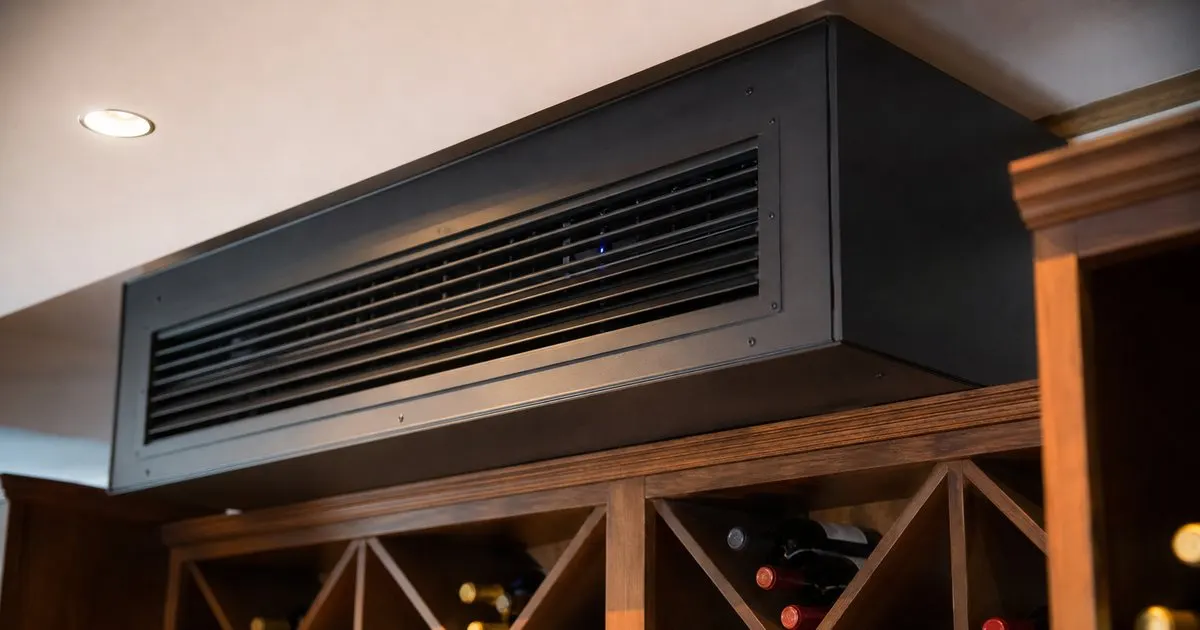
Confirm the obvious causes first. A tripped breaker, a power outage, a thermostat accidentally reset, a condenser blocked by something stored against it, or a frozen evaporator coil account for a large share of sudden failures and can be resolved without a technician. Switch the unit off for a while if it is iced, restore power if it is out, and clear anything blocking airflow. Then call the installer or the manufacturer's service line and describe exactly what you see.
Keep reading: What conditions must a private wine cellar hold to protect fine bottles?, How do you choose between passive and active cooling for a wine cellar?, What is the ideal temperature and humidity for storing wine long term?. See how Cellarvo helps you a refined guide to building and cooling a private wine cellar.
The first day: slow the warming
If the unit cannot be restored quickly, the goal is to keep the cellar as cool and as stable as possible. Turn off any lighting in the cellar, keep the door closed, and if the surrounding space is air-conditioned, lower its setpoint so the cellar's envelope is fighting a smaller temperature difference. In cool weather, a basement cellar may hold very well on its own for days. In summer, in a warm part of the house, the timeline is shorter.
If temperatures are climbing toward the mid-60s and repair is days away, consider a temporary cooler: a portable air conditioner vented into the cellar, or in a pinch, containers of ice placed on the floor, which also add humidity. These are stopgaps, not solutions, and a portable unit strips humidity aggressively, so use it with an eye on the hygrometer. What matters most is avoiding the sharp spikes into the 70s and above that actually harm wine; a slow drift to the low 60s and back is far less damaging than a rapid swing. Related: How do you choose between passive and active cooling for a wine cellar?
The first week: triage the collection
If the outage is extended, move the bottles that matter most. A wine column in the kitchen, a friend's cellar, a professional storage facility, or even the coolest interior closet in the house are all better than a room drifting into the 70s. Prioritize old, delicate, and valuable bottles, and anything with a fragile cork. Young, robust reds and most fortified wines tolerate a warm week better than an aged Burgundy or a mature Champagne. Related: What is the ideal temperature and humidity for storing wine long term?
When the unit is repaired, bring the cellar back down gradually rather than cranking the setpoint to the minimum. A rapid drop can pull humidity out of the air and stress corks that just expanded in the heat. Then check the bottles: look for seepage at the capsule, corks pushed upward, or a sticky residue, all signs that a bottle was hot enough to expand and leak. Note any affected bottles, because that record matters if you have wine insurance and want to make a claim. Related: How much does building a bespoke private wine cellar typically cost overall?
Making the next failure a non-event
The single best investment after a scare is monitoring. A wireless temperature and humidity sensor placed among the bottles, reporting to your phone and alerting you when readings leave a band you set, turns a failure discovered on Monday into one discovered within the hour. Many cellar controllers offer alerts natively; independent sensors are inexpensive and add a second opinion. Test the alert once a season so you know it still works.
Beyond monitoring, consider redundancy in proportion to the collection's value. A second, smaller cooling unit that runs only as backup, a battery or generator circuit for the cellar, and a service contract that guarantees a response time are all common in high-value cellars. Keep the installer's and service company's numbers where you can find them at nine on a Saturday night. A cellar is a machine that protects something irreplaceable, and planning for its failure is part of owning it well.
- Keep the door closed; the thermal mass of the bottles buys time, and every opening spends it.
- Check breakers, power, thermostat settings, blocked airflow, and an iced coil before calling for service.
- Slow the warming by cooling the surrounding space, and use temporary measures only with an eye on humidity.
- Add wireless monitoring with alerts and consider backup cooling or a service contract for valuable collections.

Julien Jimenez
Julien Jimenez is an independent software builder based in Paris. He designs, ships, and operates focused SaaS products for small businesses and independent professionals. Read the full author page.
A Cellar Worthy Of The Bottles
A refined guide to building and cooling a private wine cellar. Cellarvo is built to help you put this into practice.
Plan your cellarMore from the Cellarvo blog
Get the complete wine cellars guide
Our full buying guide, the price guide, and new research as we publish it. One email, no spam, unsubscribe any time.